.avif)

Dubai Real Estate Market Cycles: Identifying the Right Time to Invest
Discover how Dubai real estate cycles impact property prices, rental demand, and investment opportunities. Learn how to identify market phases, avoid common investor mistakes, and make smarter buy, hold, or sell decisions.
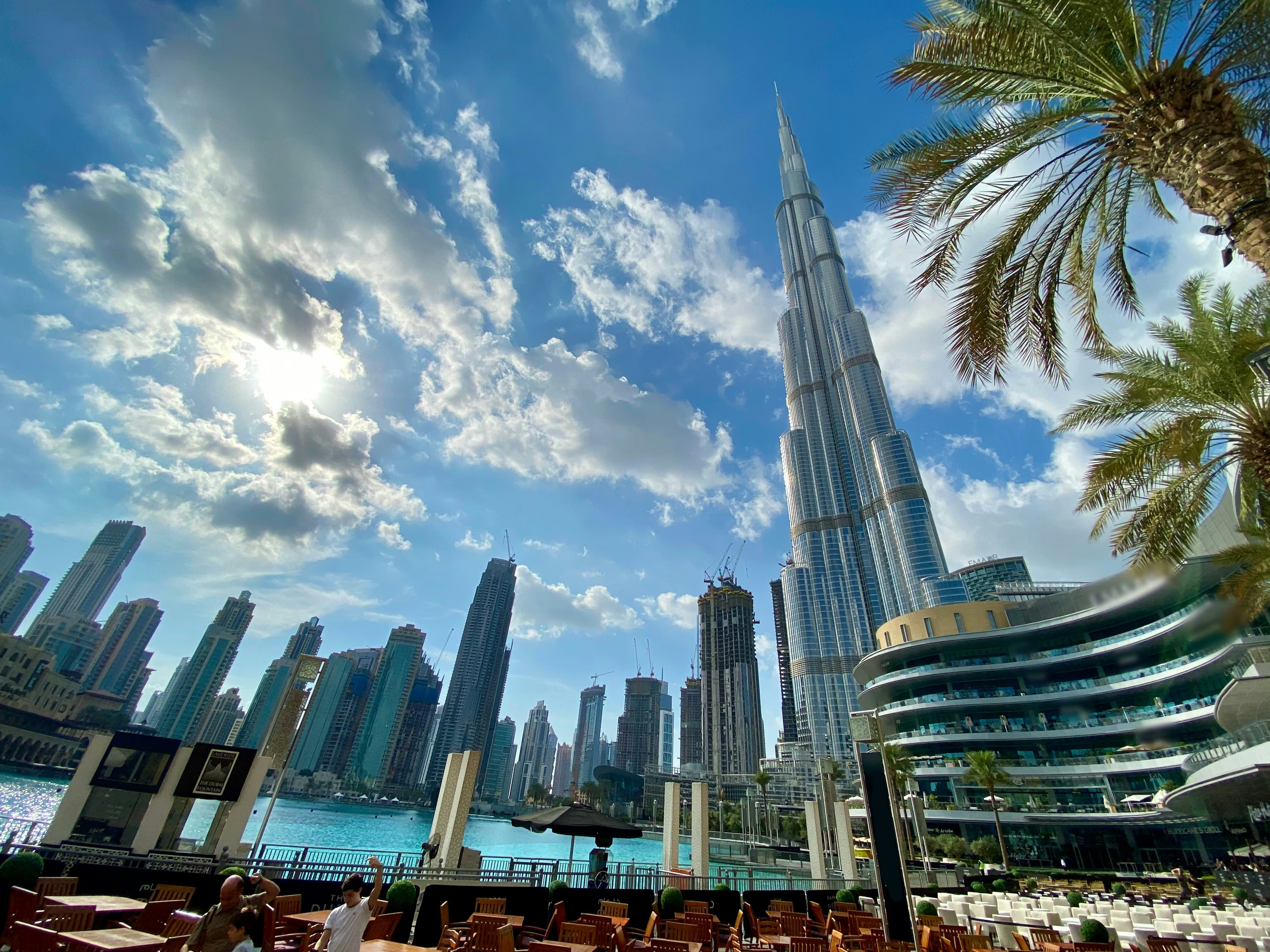
If you are investing in Dubai property, you should not only ask whether prices are rising. You should ask where the market is in the cycle, which segments are leading, and whether your asset is strong enough to hold through the next phase.
Dubai real estate evolves through different market phases, creating opportunities for informed investors at every stage. Like other leading global markets, Dubai experiences periods of growth, stabilization, and renewed momentum.
Contact us to get advice and support
Why Pay Attention To Market Cycles In Dubai
Dubai is a high-growth, internationally exposed real estate market. That makes it attractive, but it also means investor sentiment, global liquidity, supply launches, and migration trends can shift.
Understanding the cycle helps you decide whether to:
- Buy aggressively
- Buy selectively
- Hold for income and capital preservation
- Optimize your position before market conditions change
The goal is not to predict the exact top or bottom. The goal is to avoid emotional decisions and match your strategy to the market phase.
What A Real Estate Market Cycle Looks Like
A real estate cycle is the recurring movement of property markets through different phases. These phases are not always clean or perfectly timed, but they give investors a useful framework.
The four main phases are:
- Recovery: Prices stabilize after a slowdown, transaction activity improves, and early buyers return.
- Expansion: Prices rise more broadly, rents improve, developers launch new projects, and financing becomes more active.
- Peak or late cycle: Price growth becomes more aggressive, off-plan launches accelerate, yields compress, and buyers become more sensitive to quality and pricing.
- Correction or slowdown: Transaction activity softens, buyers gain negotiating power, weaker locations underperform, and prices may fall in oversupplied segments.
Dubai often moves through these market phases dynamically, driven by strong international investor demand and a continuously evolving development pipeline.
Where Dubai Appears To Be In The Current Cycle
Dubai is coming off a powerful expansion phase. In 2024, according to Deloitte, Dubai residential sales prices increased by 20% while rents rose by 19% in the same period.
That momentum continued into 2025. Based on Knight Frank’s reports published in early 2026 regarding the 2025 market performance, total residential sales value reached AED 544.2 billion (≈ USD 146.93 billion) in 2025, a record level for the market.
At the same time, investors should recognize late-cycle signals. Fitch said in May 2025 that Dubai residential prices could face a moderate correction in 2H 2025 to 2026 after peaking.
The key takeaway is this: Dubai remains a strong and opportunity-rich real estate market, but today’s environment rewards a more selective and strategic approach to investing..
What Drives Dubai’s Real Estate Cycles
Dubai’s cycles are shaped by both local fundamentals and global capital flows. If you understand the drivers, you can read the market more intelligently.
Key drivers include:
- Population growth and migration: More residents support both rents and sales demand.
- Foreign investor appetite: Global wealth flows into Dubai when the city is viewed as stable, tax efficient, and safe.
- Government policy and residency reforms: Investor visas and Golden Visa pathways increase the appeal of long-term ownership.
- Supply pipeline: Large waves of new handovers can pressure rents and sale prices in specific segments.
- Interest rates and financing conditions: Higher borrowing costs can reduce affordability, especially for mortgage buyers.
- Developer behavior: Aggressive launch activity often signals confidence, but it can also create future supply risk.
For serious investors, the most important driver to monitor right now is supply. Demand remains strong, but new deliveries can change the balance in individual communities.
How To Recognize A Recovery Phase
A recovery phase often feels uncomfortable because headlines may still be cautious. However, this is often when the best long-term opportunities appear.
Signs of recovery include:
- Prices stop falling and begin to stabilize
- Transaction volumes improve from low levels
- Rental demand starts strengthening
- Developers become more active, but not overly aggressive
- Negotiation gaps between buyers and sellers narrow
During recovery, buyers with cash, patience, and strong research often get the best entry points. The challenge is psychological. Recovery rarely feels obvious while it is happening.
How To Recognize An Expansion Phase
Expansion is easier to identify because confidence becomes visible. Buyers return, prices rise, rents increase, and developers launch new projects.
In Dubai, expansion is usually visible through:
- Rising transaction volumes
- Broad price growth across multiple areas
- Strong off-plan sales
- Higher rents and lower vacancy
- Increased international buyer activity
This phase can still be attractive for buyers, but discipline becomes more important. You should focus on assets with durable demand rather than buying purely because the broader market is moving.
How To Recognize A Late-Cycle Market
A late-cycle market does not necessarily signal a downturn. It simply means that investors benefit more from being selective and focusing on opportunities with the strongest long-term fundamentals.
Typical late-cycle signs include:
- Fast price growth over several years
- Heavy off-plan launch activity
- Strong media attention and investor enthusiasm
- Falling rental yields as prices rise faster than rents
- Buyers stretching budgets to secure deals
- More similar projects competing in the same areas
Dubai now shows some of these characteristics. For buyers, this creates an opportunity to focus on high-quality projects, strong locations, and properties with solid long-term potential. In today’s market, a strategic and selective approach can lead to some of the strongest investment outcomes.
What A Correction Phase Usually Looks Like
Corrections are a normal part of real estate markets. They do not affect all assets equally.
In Dubai, a correction may show up as:
- Slower transaction volumes
- More negotiation room for buyers
- Longer listing periods
- Softer pricing in oversupplied communities
- Weaker performance in lower-quality buildings
- Developers offering more incentives
Prime, scarce, and well-managed assets usually hold up better than generic units in heavily supplied locations. This is why asset quality matters before the correction happens, not after.
When To Buy
You should consider buying when the price, asset quality, and your holding period align. The best time is not always the lowest point in the cycle.
Buying can make sense when:
- You plan to hold for at least five to seven years
- The property has strong tenant or end-user demand
- The price is supported by recent comparable transactions
- The community has controlled or absorbable future supply
- Financing costs and service charges still leave a sensible margin
- You are not relying on short-term resale gains
Different market phases create different types of opportunities. During a recovery phase, buyers may benefit from strong upside potential. In an expansion phase, well-selected investments can continue to perform strongly. And in a more mature phase of the cycle, a disciplined and selective approach becomes increasingly important for achieving long-term success.
When To Hold
Holding is often the most underrated strategy in Dubai real estate. Investors sometimes sell too early, even when they own a strong asset with reliable income.
Holding usually makes sense when:
- The property is generating healthy rental income
- The asset is in a proven location
- Your financing is manageable
- You would struggle to replace the same quality at a better price
- The market slowdown is temporary rather than structural
- Your long-term thesis remains intact
If your property remains liquid, rentable, and well located, holding through a cycle can outperform constant trading.
When To Exit
Exiting should be a strategic decision, not an emotional reaction to headlines.
You may consider selling when:
- Your area has heavy upcoming supply and weak differentiation
- Your rental yield has compressed meaningfully
- The property has reached your target return
- You are overexposed to one location or property type
- Maintenance or service charges are eroding net income
- Better opportunities exist elsewhere in your portfolio
A smart exit strategy is not necessarily about timing the exact market peak. It is about managing your portfolio proactively and recognizing when preserving gains and rebalancing exposure may create stronger long-term opportunities.
Why Micro-Markets Matter More Than Headlines
Dubai is not one market. It is a collection of micro-markets.
Apartments, especially luxury apartments, such as in JVC, villas in Dubai Hills, waterfront units in Palm Jumeirah, and older towers in Dubai Marina can all behave differently during the same cycle. Citywide averages are useful for context, but they can mislead you if you apply them directly to one property.
Before you buy, hold, or exit, study:
- Recent transactions in the same building or community
- Rental trends for that exact property type
- New launches nearby
- Service charge levels
- Buyer and tenant profile
- Resale liquidity
A weak asset in a rising market can still be a poor investment. A strong asset in a slower market can still be worth holding.
Common Mistakes Investors Make During Cycles
Market cycles create emotional pressure. The best investors stay disciplined while others overreact.
Common mistakes include:
- Buying late-cycle properties purely because prices have been rising
- Selling strong income-producing assets during temporary slowdowns
- Ignoring new supply in the surrounding area
- Comparing villa trends with apartment trends as if they are the same
- Treating off-plan launch success as guaranteed future resale demand
- Overleveraging during expansion phases
- Assuming prime assets and generic assets carry the same risk
The core mistake is confusing market momentum with asset quality.
How To Build A Cycle-Resilient Dubai Portfolio
A cycle-resilient portfolio is not built around hype. It is built around liquidity, income, location, and flexibility.
Consider these principles:
- Balance income and appreciation: Combine yield-focused properties with assets in stronger long-term locations.
- Avoid excessive concentration: Do not put all capital into one building, developer, or property type.
- Prioritize liquidity: Buy properties with a broad resale audience.
- Respect service charges and maintenance: Net income matters more than gross rent.
- Keep leverage manageable: Holding power is what allows you to survive corrections.
- Focus on scarcity: Waterfront, prime villa plots, protected views, and proven communities usually hold value better than easily replicated stock.
The investors who perform best across cycles are rarely the ones chasing every launch. They are usually the ones who buy carefully, hold patiently, and exit rationally.
Final Thoughts
Dubai real estate cycles are not something to fear. They are something to understand. The market can remain attractive even when it becomes more selective, but you need to know whether you are buying into recovery, expansion, late-cycle momentum, or a potential slowdown.
Use the cycle to guide your behavior:
- Buy when fundamentals and pricing align
- Hold when the asset remains strong and income supports patience
- Exit when your return target has been achieved and market conditions begin to shift
That is how you move from reacting to headlines to investing with discipline.
Contact an RD Dubai specialist for personalized guidance on:
- Current market conditions and pricing trends
- High-potential communities and property types
- Supply and resale risk analysis
- Investment-focused property selection
- Buy, hold, or exit strategy planning
Speak with RD Dubai today and make your next real estate decision with greater clarity and confidence.
Frequently Asked Questions
What is the real estate market cycle?
A real estate market cycle refers to the recurring phases every property market goes through, including recovery, expansion, peak, and correction. Each phase affects pricing, rental demand, and investor behavior differently.
Should I sell my Dubai property before a market correction?
That depends on your investment goals, financing structure, rental income, and asset quality. Prime properties with strong demand often perform better during corrections than generic or oversupplied units.
Why do some Dubai communities perform better than others during market cycles?
Different areas react differently to supply, demand, infrastructure growth, and buyer preferences. Prime waterfront and established communities often remain more resilient than areas with heavy future supply.
What is the biggest mistake investors make during Dubai market cycles?
One of the most common mistakes is making emotional decisions based on headlines instead of focusing on long-term fundamentals such as location quality, rental demand, liquidity, and supply risk.

.avif)